
English Electric Lightning - Survivors
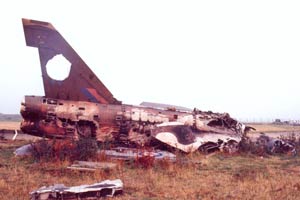
Sadly not all can be saved - XN774 was used for fire crew training duties, ending up as a prop in a crash training scenario at RAF Coningsby before finally being buried under a pile of gravel; Nick Challoner
Lightnings have thankfully survived retirement very well, with many airframes preserved throughout the UK (and a few elsewhere). Some are even flying, though not in the UK. The sheer popularity of the Lightning is evident in the number that have ended up in museums - and not only just parked on the nearest bit of grass, but often pampered with nice air-conditioned hangars! Given the importance of the Lightning in beginning Britain's defence exports to the Middle East and its advanced design for its time, it is only fitting that you don't have to travel far to find at least one of these wonderful pieces of aviation history.
The list here is compiled from a number of sources, with particular credit to Wrecks & Relics, Military Aircraft Markings, Lightnings Live On, Demobbed and of course many visitor contributions.
Click on the serial of a survivor entry for further information. Please comment on any individual survivor entry you feel requires an update!
Complete aircraft
| Serial | Mark | Owner & location | Updated |
| WG768 | SB.5 | RAF Museum Cosford, (stored), Shropshire | 12/06/2023 |
| Serial | Mark | Owner & location | Updated |
| WG760 | P.1A | RAF Museum Cosford, (stored), Shropshire | 12/06/2023 |
| WG763 | P.1A | Boscombe Down Aviation Collection, Old Sarum Airfield, Wiltshire | 18/03/2023 |
| Serial | Mark | Owner & location | Updated |
| XA847 | P.1B | Giles Howell (stored), Kettleburgh, Suffolk | 20/06/2021 |
| Serial | Mark | Owner & location | Updated |
| XG313 | F.1 | RSAF, Dhahran, Saudi Arabia | |
| XG329 | F.1 | Ian Hancock, Norfolk & Suffolk Aviation Museum, Flixton, Norfolk | 08/06/2023 |
| XG337 | F.1 | RAF Museum Midlands, RAF Cosford, Shropshire | 24/04/2022 |
| XM135 | F.1 | Imperial War Museum, Duxford Airfield, Cambridgeshire | 28/05/2023 |
| Serial | Mark | Owner & location | Updated |
| XM172 | F.1A | Lakes Lightnings, Spark Bridge, Cumbria | 08/06/2023 |
| XM173 | F.1A | Dyson Ltd. (on display in staff canteen), Malmesbury, Wiltshire | 18/06/2021 |
| XM178 | F.1A | Association des Amis du Musee du Chateau, Savigny-Les-Beaune, France | 08/06/2026 |
| XM192 | F.1A | Charles Ross, Thorpe Camp Visitor Centre, Woodhall Spa, Lincolnshire | 08/06/2023 |
| Serial | Mark | Owner & location | Updated |
| XN730 | F.2A | Militärhistorische Museum der Bundeswehr, Flugplatz Gatow, Berlin, Germany | 08/06/2023 |
| XN776 | F.2A | National Museum of Flight, East Fortune Airfield, Lothian, Scotland | 27/06/2022 |
| XN782 | F.2A | Luftfahrtausstellung Museum, Hermeskeil, Germany | 08/06/2023 |
| XN784 | F.2A | Zruc Air Park, Pilsen, Czech Republic | 16/06/2022 |
| Serial | Mark | Owner & location | Updated |
| XP706 | F.3 | South Yorkshire Aircraft Museum, Doncaster, South Yorkshire | 22/06/2022 |
| XP745 | F.3 | Vanguard Haulage, Greenford, Greater London | 08/06/2023 |
| XR713 ('XR718') | F.3 | Lightning Preservation Group, Bruntingthorpe Aerodrome, Leicestershire | 02/06/2022 |
| XR718 | F.3 | Anthony Harker, Over Dinsdale, Darlington, Durham | 24/10/2021 |
| XR749 | F.3 | Score Group PLC (gate guard), Glenugie Engineering Works, Peterhead, Aberdeenshire | 29/04/2012 |
| Serial | Mark | Owner & location | Updated |
| XL629 | T.4 | MoD Boscombe Down (displayed near gate), Wiltshire | 08/05/2023 |
| Serial | Mark | Owner & location | Updated |
| XS416 | T.5 | Dave and Lesley Blissett, Binbrook, Lincolnshire | 31/08/2021 |
| XS417 | T.5 | Newark Air Museum, Winthorpe, Nottinghamshire | 13/04/2021 |
| XS420 | T.5 | Richard Hall, Farnborough Air Sciences Trust Museum (gate guard), Farnborough, Hampshire | 22/12/2022 |
| XS422 | T.5 | Anglo-American Lightning Organisation (restoration to fly), Stennis International Airport, Hancock County, Mississippi, USA | 17/10/2008 |
| XS456 | T.5 | Skegness Airfield, Ingoldmells, Lincolnshire | 29/12/2020 |
| XS458 | T.5 | Russell Carpenter, Cranfield, Bedfordshire | 05/07/2021 |
| XS459 | T.5 | Ian Black, Binbrook, Lincolnshire | 03/05/2021 |
| ZU-BBD (ex XS452) | T.5 | Privately owned, (for sale, stored), Cape Town International Airport, South Africa | 25/11/2022 |
| Serial | Mark | Owner & location | Updated |
| XP693 (ex ZU-BEY, ex G-FSIX) | F.6 | Ian Black, Binbrook. Lincolnshire | 12/07/2023 |
| 'XP765' (really XS897) | F.6 | Lakes Lightnings, RAF Coningsby (29 Sqn, displayed), Lincolnshire | 22/06/2022 |
| XR724 | F.6 | Lightning Association, Binbrook airfield, Lincolnshire | 06/04/2025 |
| XR725 | F.6 | Charles Ross, Chestnut Farm, Binbrook village, Lincolnshire | 07/04/2023 |
| XR728 | F.6 | Lightning Preservation Group (runner), Bruntingthorpe, Leicestershire | 02/06/2022 |
| XR753 | F.6 | RAF Coningsby (11 Sqn mascot, displayed), Lincolnshire | 17/12/2021 |
| XR755 | F.6 | Ernie Marshall, near Callington, Cornwall | 11/10/2022 |
| XR770 | F.6 | RAF Manston History Museum, Manston, Kent | 30/12/2015 |
| XR771 | F.6 | Midland Air Museum, Coventry Airport, Warwickshire | 16/05/2022 |
| XR773 (ZU-BEW, ex G-OPIB) | F.6 | Privately owned, (stored), Cape Town International Airport, South Africa | 25/11/2022 |
| XS903 | F.6 | Yorkshire Air Museum, Elvington, North Yorkshire | 25/09/2023 |
| XS904 | F.6 | Lightning Preservation Group (runner), Bruntingthorpe, Leicestershire | 14/11/2022 |
| XS919 | F.6 | Henstridge Airfield (stored), Somerset | 01/07/2014 |
| XS925 | F.6 | RAF Museum London, Hendon, London | 23/04/2023 |
| XS928 | F.6 | BAE Systems, Warton (displayed within the site), Lancashire | 17/10/2008 |
| XS929 | F.6 | RAF Akrotiri (gate guardian), Cyprus | 05/08/2021 |
| XS936 | F.6 | Roy Flood, Castle Air/Castle Motors, on A38 near Liskeard, Cornwall | 11/10/2022 |
| Serial | Mark | Owner & location | Updated |
| 52-609 (ex 52-655, XN767) | F.52 | Technical Services Institute, Dhahran, Saudi Arabia | |
| 52-610 (ex 52-656, XN770) | F.52 | Saqr al Jazira (RSAF) Museum, Riyadh, Saudi Arabia | 23/10/2008 |
| Serial | Mark | Owner & location | Updated |
| 53-412 | F.53 | Kuwait International Airport, Kuwait | 28/11/2021 |
| 53-415 | F.53 | RKAFB Al Jaber (gate guardian), Kuwait | |
| 53-416 | F.53 | RKAFB Al Jaber (gate guardian), Kuwait | |
| 53-417 | F.53 | RKAFB Al Jaber (gate guardian), Kuwait | |
| 53-418 | F.53 | Educational Science Museum, Kuwait City, Kuwait | 28/11/2021 |
| 53-420 | F.53 | Kuwait Technology Institute, Kuwait | 28/11/2021 |
| 53-421 | F.53 | MOD Mubarak Camp Headquarters, Kuwait-City. Kuwait | 24/12/2021 |
| 53-422 | F.53 | RKAFB Ali Al Salem (gate guardian), Kuwait | 28/11/2021 |
| 53-423 | F.53 | RKAFB Ali Al Salem (gate guardian), Kuwait | 28/11/2021 |
| 53-671 | F.53 | Gatwick Aviation Museum (runner), Charlwood, Surrey | 07/08/2023 |
| 53-684? ('1303') | F.53 | Displayed, Taif, Saudi Arabia | 07/02/2009 |
| 53-687 | F.53 | RSAF, Khamis Mushayt, Saudi Arabia | |
| 53-698 | F.53 | RSAF Tabuk (gate guardian?), Saudi Arabia | 23/10/2008 |
| 53-699 | F.53 | RSAF Tabuk, Saudi Arabia | 23/10/2008 |
| 'XP748' (really ZF583, ex 53-681) | F.53 | Solway Aviation Museum, Carlisle Airport, Cumbria | 20/08/2023 |
| 'XR753' (really ZF578, ex 53-670) | F.53 | Tangmere Military Aviation Museum, Tangmere, West Sussex | 19/10/2008 |
| 'XS933' (really ZF594, ex 53-696) | F.53 | North East Land Sea & Air Museum, Sunderland Airport, Tyne & Wear | 27/06/2022 |
| 'XS935' (really ZF580, ex 53-672) | F.53 | Binbrook Airfield, Binbrook, Lincolnshire | 02/02/2025 |
| ZF581 (ex 53-675) | F.53 | Bentwaters Cold War Museum, Bentwaters airfield, Suffolk | 09/12/2020 |
| ZF584 (ex 53-682) | F.53 | Dumfries & Galloway Aviation Museum, Dumfries, Dumfries & Galloway, Scotland | 31/08/2021 |
| ZF588 (ex 53-693) | F.53 | East Midlands Aeropark, Castle Donnington, Derbyshire | 25/02/2022 |
| ZF591 (ex 53-685) | F.53 | Location unknown | |
| ZF592 (ex 53-686) | F.53 | City of Norwich Aviation Museum, Horsham St. Faith, Norfolk | 05/12/2022 |
| ZF593 (ex 53-692) | F.53 | Pima Air & Space Museum, Tucson, Arizona, USA | 15/06/2021 |
| Serial | Mark | Owner & location | Updated |
| 54-607 (ex 54-650, XM989) | T.54 | RSAF (displayed), Dhahran Airport, Saudi Arabia | |
| 54-608 (ex 54-651, XM992) | T.54 | Prince Sultan Air Base (gate guard), Al Kharj, Saudi Arabia | 01/11/2008 |
| Serial | Mark | Owner & location | Updated |
| 55-410 | T.55 | RKAFB Ali Al Salem (wreckage, derelict), Kuwait | 28/11/2021 |
| 55-411 | T.55 | Air Museum, Kuwait International Airport, Kuwait | |
| 55-713 (ZF598) | T.55 | Midland Air Museum, Coventry Airport, Warwickshire | 16/05/2022 |
| 55-716 | T.55 | Saqr al Jazira (RSAF) Museum, Riyadh, Saudi Arabia | 23/10/2008 |
Nose/cockpit/other sections
| Serial | Mark | Owner & location | Updated |
| N/A | Simulator | Tangmere Military Aviation Museum, Tangmere, West Sussex | 22/01/2012 |
| 'XM171' | Simulator | Farnborough Air Sciences Trust (cockpit), Farnborough, Hampshire | 20/10/2008 |
| Serial | Mark | Owner & location | Updated |
| XG325 | F.1 | Privately owned, Thetford, Norfolk | 22/08/2012 |
| XG331 | F.1 | Gloster Aviation Club, Gloucestershire | 31/08/2024 |
| Serial | Mark | Owner & location | Updated |
| XM144 | F.1A | Atlantic Air Adventures, Shannon, Clare, Eire | 19/08/2022 |
| XM169 | F.1A | Ken Ward, Morayvia, Kinloss, Scotland | 19/07/2021 |
| XM191 | F.1A | Privately owned, North Scarle, Lincolnshire | 19/10/2008 |
| Serial | Mark | Owner & location | Updated |
| XN769 | F.2 | Malta Aviation Museum, Ta' Qali, Malta | 24/06/2021 |
| Serial | Mark | Owner & location | Updated |
| XN726 | F.2A | Boscombe Down Aviation Collection, Old Sarum Airfield, Wiltshire | 30/03/2023 |
| XN728 (8546M) | F.2A | Darren Swinn, Lincolnshire | 01/09/2021 |
| XN795 | F.2A | Carl Lamb, Neatishead, Norfolk | 22/07/2022 |
| Serial | Mark | Owner & location | Updated |
| XP701 | F.3 | Robertsbridge Aviation Society, Mayfield, East Sussex | 13/10/2013 |
| XP703 | F.3 | Lightning Preservation Group, Bruntingthorpe Aerodrome, Leicestershire | 24/10/2021 |
| XP743 | F.3 | Ken Hayward, Norfolk & Suffolk Aviation Museum, Flixton, Norfolk | 28/06/2022 |
| XP757 | F.3 | Martyn Steele (cockpit only), Stamford, Lincolnshire | 25/10/2008 |
| XR751 | F.3 | Jet Art Aviation, Selby, North Yorkshire | 01/07/2011 |
| Serial | Mark | Owner & location | Updated |
| XS421 | T.5 | Carl Lamb, Neatishead, Norfolk | 22/07/2022 |
| XS457 | T.5 | Ray Whiteley, Binbrook, Lincolnshire | 07/04/2025 |
| XV328 | T.5 | Lightning Preservation Group, Bruntingthorpe, Leicestershire | 24/10/2021 |
| Serial | Mark | Owner & location | Updated |
| XR726 | F.6 | Privately owned, (Internal fittings only), Binbrook, Lincolnshire | 08/08/2022 |
| XR747 | F.6 | Privately Owned, Bideford, Devon | 02/08/2021 |
| XR754 | F.6 | Matt Buddle, Upwood, Cambridgeshire | 24/06/2021 |
| XR757 | F.6 | Privately owned, Newark Air Museum, Winthorpe Show Ground, Nottinghamshire | 10/07/2022 |
| XR759 | F.6 | Glenn Edwards, North Weald, Essex | 17/07/2021 |
| XS898 | F.6 | Tony Collins, Lavendon, Buckinghamshire | 02/09/2022 |
| XS899 | F.6 | Charles Ross, Binbrook, Lincolnshire | 07/04/2023 |
| XS922 | F.6 | Lakes Lightnings (cockpit), Spark Bridge, Cumbria | 10/07/2022 |
| XS923 | F.6 | Sue & Roy Jerman, Welshpool, Powys, Wales | 02/09/2022 |
| XS932 | F.6 | Richard Scarborough, Walcott, Lincolnshire | 03/12/2020 |
| XS933 | F.6 | Mike Patterson, Binbrook, Lincolnshire | 07/04/2025 |
| Serial | Mark | Owner & location | Updated |
| 53-700 | F.53 | Gatwick Aviation Museum, Charlwood, Surrey | 29/06/2021 |
| ZF577 (ex 53-668) | F.53 | Pinewood Film Studios (nose only?), Buckinghamshire | 19/10/2008 |
| ZF582 (ex 53-676) | F.53 | Bournemouth Aviation Museum, Hurn, Dorset | 16/06/2022 |
| ZF586 (ex 53-688) | F.53 | Pinewood Film Studios (nose only?), Buckinghamshire | 19/10/2008 |
| ZF587 (53-691) | F.53 | Mike Coleman, Lashenden Air Warfare Museum, Headcorn, Kent | 30/06/2021 |
| ZF587 (ex 53-691) | F.53 | Giles Howell (stored - fuselage, wings, tail), Kettleburgh, Suffolk | |
| ZF590 (ex 53-679) | F.53 | Lincair (fuselage), Binbrook, Lincolnshire | 19/10/2008 |
| ZF590 (ex 53-679) | F.53 | Gloster Aviation Club, Gloucestershire | 31/08/2024 |
| Serial | Mark | Owner & location | Updated |
| ZF595 (ex 55-714) | T.55 | North Weald, Essex | 03/12/2020 |
| ZF595 (ex 55-714) | T.55 | Lincair (fuselage, stored), Binbrook, Lincolnshire | 07/04/2025 |
| ZF596 (ex 55-715) | T.55 | North Weald, Essex | 17/07/2021 |
| ZF596 (ex 55-715) | T.55 | Lakes Lightnings (nose), Spark Bridge, Cumbria | 06/02/2012 |
| ZF597 (ex 55-711) | T.55 | Privately owned, Unknown location | 08/05/2019 |