[Thunder & Lightnings]
[Buccaneer] [Gannet] [Gnat] [Hunter] [Javelin] [Lightning] [Phantom]
[Scimitar] [Sea Hawk] [Sea Vixen] [Swift] [TSR.2] [Valiant] [Victor] [Vulcan]
[Airfield Viewing Guide] [Links] [Forum]

AVRO VULCAN
PICTURES - SURVIVORS

[History] [Vulcan to the Sky] [Survivors & Leading Particulars] [Pictures] [References & Credits]
This page last updated on 21st October 2007

Help return Vulcan XH558 to flight

[Survivors 1] [Survivors 2] [Survivors 3]
[Gallery 1] [Gallery 2] [Gallery 3] [Gallery 4] [Cockpit] [Fuselage] [Wings] [Undercarriage] [Weapons]

NOSE/COCKPIT/OTHER SECTIONS

XA893; 16,959 bytes

XA903; 13,402 bytes

B.1 XA893 at Cosford, 8th May 2003; author B.1 XA903 at Wellesbourne, 26th September 1999; author
Above is B.1 XA893's nose at the Aerospace Museum at Cosford. As you can see they've cut two big holes in the side of this nose, so people can walk through it. You walk into the rear crew compartment, which has a platform surrounded by railings in place of the seats, and the view up into the pilots area is nice and clear, because they've removed just about everything on the starboard side up there. The visual bomb aiming blister is gone, as the exit from the nose now runs down the centre and into where the radar would have been. Information current as of 08/05/2003.       Owned for some time by mega Vulcan fan Colin Mears and sat in his back garden, XA903 has been added to Paul Hartley's collection, and has left Colin's lawn to join XM655 at Wellesbourne. 903 is in generally good nick inside but has suffered some exterior damage, particularly to the canopy and has been estimated as needing 2,500 man hours to restore her to complete condition. She was the last B.1 to fly, being used as a flying testbed for the Olympus engines used on Concorde. Flown for a while with the underslung Olympus installation, that made it a five-Olympus aircraft! After its last flight 903 survived for some time at Farnborough becoming ever more decrepit until it was finally scrapped. So there went the last flying B.1 - another historic aircraft consigned to the scrap heap... XA903 has a web site now too. Information current as of 21/05/2005.

XL388; 19,876 bytes

XL391; 29,421 bytes

B.2 XL388 at Doncaster, 10th May 2003; Bob Lawson B.2 XL391 at Blackpool Airport, 18th February 2005 (top - author)
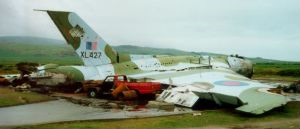
and then being scrapped, 12th January 2006; Russell Pinfold
XL388 was the original Vulcan restoration project at the Blyth Valley Aviation Collection until the owner passed away; his father kept it on though 388 was on the back burner while XL445 received most of his attention, being in better overall condition to start with. 388's visual bomb aiming blister is crushed and access to the cockpit wasn't possible. Put up for sale in 2002, she has now been purchased by Mike and John and was moved to the Aeroventure museum in Doncaster in April 2003. Restoration has now commenced. Information current as of 10/05/2003.       Now a rather sadder story... XL391, above, was the example at Blackpool Airport here in the UK. Unfortunately the sea air of Blackpool, the northern weather and her owner were not kind to her. The exhaust cowlings had gone, the engine mounts were rusting fast; the landing gear was increasingly unsafe (the nose leg was actually cracked) and she was sinking into the sandy soil. The cockpit was open to the public for an entrance fee but most of the instruments and controls including both joysticks had been removed, stolen or smashed by vandals. The aircraft was up for sale for some time, with the owner apparently asking a price that was rather too high considering the condition of the old girl. Eventually he got fed up with the lack of interest and put it on eBay, where - incredibly - it sold for a sum of more than £15,000 - far more than it was worth. The new owner, a publican from Dukinfield near Manchester, apparently planned to park the aircraft next to his pub as an attraction. However he clearly had no idea of the poor state of the airframe, and didn't attempt to find this out before the purchase. Predictably, therefore, there were soon reports of him attempting to get his money back (unsuccessfully), while parking fees continued to mount. Eventually he gave the airframe back to its owner and made a settlement for the parking fees. The owner then finally sold it to a scrap merchant and it was hacked to bits on January 12th/13th. Sandbach, the scrap merchants involved, made a poor attempt at 'saving' the nose, damaging it so badly in the process it wasn't worth much. Sure enough when offered on eBay for £2,000 there were no bidders. When a direct approach was made to them to buy the nose, they wanted £4,000! Needless to say it did not sell and was scrapped along with the engines a few days later. A sad and predictable end to a tale of neglect and a lesson in how not to preserve an aircraft! Information current as of 21/02/2006.

XM569; 27,961 bytes

XM602; 18,943 bytes

B.2 XM569 at the Wales Air Museum in 1989 (top; Colin Mears) and then at the Jet Age Museum, 20th April 2000 (bottom; Bob Lawson) B.2 XM602 at RAF Cottesmore, 28th July 2001; author
Now onto XM569. This one's a B.2 and is all that remains of the full aircraft that was displayed at the Wales Air Museum at Cardiff airport. The collection there expanded very quickly yet had no buildings to house the aircraft in at all, and being near the sea the salt air quickly made corrosion a big problem in their aircraft. The museum's owners didn't really treat the aircraft as historic exhibits - and applied some unusual paint schemes (e.g. RAF and then RAF Gulf War paint schemes on a Mk.1 Buccaneer!). Eventually the museum collapsed and the collection was dispersed; several of the aircraft were rescued, but a good number were scrapped. XM569 was one of the unlucky ones but the nose section was saved. It was used to advertise a new leisure centre (The Planets) in Woking - made up as a rocket with silver paint and attached fins. It sounds bad, doesn't it! But thankfully when that task was complete, XM569's luck changed for the better. The fins were removed and the owners loaned it to the Jet Age Museum at Staverton - where it is now displayed on a raised framework with the access ladder down so that visitors can take a look inside. Inside the nose is in good condition with only a few missing instruments. The museum's volunteers hope to light up the cockpit in the same manner as their Canberra's cockpit (which looks superb - roll on similar treatment for XM569), and have stripped off most of the silver paint to reveal the camouflage colours once more. Unfortunately the museum has been forced to shut its doors by the airport authorities who want to demolish the hangar that the museum use, so for the time being this aircraft is not accessible. Information current as of 20/04/2000.       Also being looked after well is XM602. Since arrival at Woodford the nose has been repainted and mounted on a frame so the cockpit hatch can be opened. Wheeled out of its own little hangar for the annual airshow at Woodford, the Avro Heritage Society looked after this nose and let visitors into it for a small fee. The co-pilot's seat has been removed to ease access for visitors and lots of the rear crew's instruments are missing but otherwise the interior is in good condition. She's currently being used as a travelling exhibit by Vulcan To The Sky to drum up support for the XH558 Return to Flight project, and is stored outside at Bruntingthorpe in between her travels. Information current as of 20/10/2007.

XM652; 12,296 bytes

XH537; 23,123 bytes

B.2 XM652 at Welshpool (though not when this picture was taken); Colin Mears B.2MRR XH537 at Hurn, April 2003; Paul Hartley
Finally, XM652. Now owned by Sue and Roy Jerman on their farm at Welshpool, 652 is part of a large private collection of aircraft nose sections, and is currently the only one outdoors. Hopefully this will change soon and it will be mounted appropriately to give access to the cockpit. Information current as of 2002.       Built in 1959, XH537 was delivered to Boscombe Down on the 31st August. In January 1960 she was chosen to be one of the Skybolt development aircraft and in June 1961 work was complete and she flew with dummy Skybolts (one of which is now preserved at Cosford). After Skybolt's cancellation, she had her Skybolt kit removed and entered normal RAF service with 230 OCU at RAF Finningley. In 1978 she was converted to a B.2MRR and moved to 27 Squadron. In March 1982, as other Vulcans were being prepared to go to war, she made her last flight, being delivered to Abingdon to be a maintenance airframe. She lasted for nine years, being scrapped in May 1991. The nose was saved and bought by Vulcan fan Colin Mears in 1994, moving on to another fan - Paul Hartley - in 1997. There had been a plan for XH537's nose to carry out a final duty - acting as a crew escape and rescue trainer for XH558, however in late 2001 she moved to Hurn instead, and her restoration (sponsored by Channel Express) was carried out there (as you can see). In March 2003 she was sold to the museum and has a permanent home there. XH537 has her own web site. Information current as of 21/06/2003.

XH563; 19,602 bytes

XL445; 18,320 bytes

B.2MRR XH563 at Bruntingthorpe, 21st May 2003; Paul Hartley K.2 XL445 at Walpole, 3rd December 2001; Paul Hartley
Built in 1960, XH563 was delivered to 83 Squadron at RAF Scampton in December of that year, the first B.2 to be delivered to any frontline unit. With 83 becoming a Blue Steel squadron, XH563 was moved on to 12 Squadron at RAF Coningsby in November 1962. It was a short stay and in June 1963 she was returned to Woodford to be converted to Skybolt fit and flew to the USA for electrical trials work. Skybolt was cancelled soon afterwards. She returned to the RAF - 230 OCU - at RAF Finningley in 1965, and in 1968 was transferred to the Waddington Wing (a shared pool of aircraft used by 44, 50 and 101 Squadrons) before returning to the OCU in 1969. She spent some time on loan to the Ministry of Technology but by the end of 1969 was back with the OCU, by this time at Scampton. In 1971 she was returned to Woodford for conversion to B.2MRR status and re-entered service with 27 Squadron in December 1973. Retired in 1982, she became a maintenance airframe at Scampton but her stay was a short one and she was scrapped in 1986. Donald Milne and of Banchory bought the nose section as a tree house for his 6 year old son! In 2003 Vulcan fanatic Paul Hartley bought her. She is currently stored at Bruntingthorpe (pictured above arriving at the aerodrome) and is now up for sale again. The interior is mainly complete and the exterior is also in good condition, just one tear in the skin which can be fixed. It also comes complete with nose wheel strut and wheels! Information current as of 20/10/2007.       XL445 is now the only Vulcan nose at Walpole. Mounted on a (somewhat makeshift) frame so that the cockpit access hatch can be opened and you can go inside, XL445 (service nickname - Fireball XL445 - of course!) is the only K.2 in existence (unless you count XH558 which was a K.2 before being converted back to near-B.2 status. The rear cockpit is in pretty good condition with only a few missing instruments; the pilot's panels are being worked on to restore that area - apparently RAF personnel did a lot of souvenir hunting while XL445 waited to be scrapped, and most of the instruments along with the joysticks were forcibly removed. She's in desperate need of a clean or repaint! Information current as of 2003.

[Previous] [Next]

[Back to top]


All these pages and 'author' credited images copyright © 1997-2007 Handmade by Machine Ltd.