
Avro Vulcan - Survivors
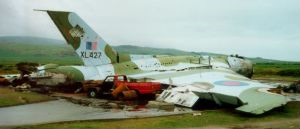
XL427 when used for fire crew training and nearing the end of her days; Colin Mears
The bad old days of entire production runs of aircraft being scrapped are thankfully well behind us, and there are a good number of preserved Vulcans out there, with two in running condition and one airworthy (XH558). The Vulcan's part in the NATO nuclear deterrent force meant that not only have Vulcans been preserved in the UK, four are also preserved on the North American continent; three in the U.S. and one in Canada. Of course, even more were scrapped or burned, and even some of those that were thought safe have since fallen to the scrapman's JCBs and cutting torches - for instance the B.1 at Cosford (XA900), and the B.2s at Cardiff (XM569) and Blackpool (XL391). If you have pictures of Vulcans you'd like to share with the world, please, let me know! I'd especially welcome pictures of the aircraft that aren't linked to in the list below.
Complete aircraft
| Serial | Mark | Owner & location | Updated |
| XH558 (G-VLCN) | B.2 | Vulcan to the Sky Trust (runner), Robin Hood Airport, Doncaster, Yorkshire | 21/05/2024 |
| XL318 | B.2 | RAF Museum London, Hendon, North London | 20/05/2023 |
| XL319 | B.2 | North East Land Sea & Air Museum, Sunderland Airport, Tyne & Wear | 27/06/2022 |
| XL361 | B.2 | Happy Valley - Goose Bay, Canada | 06/06/2021 |
| XL426 | B.2 | Vulcan Restoration Trust (taxiable), Southend Airport, Essex | 16/09/2021 |
| XM573 | B.2 | Strategic Air Command & Aerospace Museum, Ashland, Nebraska, USA | 23/10/2022 |
| XM594 | B.2 | Newark Air Museum, Newark, Nottinghamshire | 21/05/2024 |
| XM597 | B.2 | National Museum of Flight, East Fortune Airfield, Lothian, Scotland | 28/06/2022 |
| XM598 | B.2 | RAF Museum Midlands, RAF Cosford, Shropshire | 24/04/2022 |
| XM603 | B.2 | Harrow Estates / Avro Heritage Museum, Woodford, Cheshire | 10/02/2024 |
| XM605 | B.2 | Castle Air Museum, Castle AFB, Atwater, California, USA | 21/01/2021 |
| XM606 | B.2 | Eighth Air Force Museum, Barksdale AFB, Bossier City, Louisiana, USA | 13/03/2021 |
| XM607 | B.2 | RAF Waddington (under restoration), Lincolnshire | 17/08/2021 |
| XM612 | B.2 | City of Norwich Aviation Museum, Horsham St. Faith, Norfolk | 05/12/2022 |
| XM655 | B.2 | John Littler/655 MaPS (taxiable), Wellesbourne Mountford Aerodrome, Warwickshire | 02/10/2022 |
| Serial | Mark | Owner & location | Updated |
| XJ824 | B.2A | Imperial War Museum, Duxford Airfield, Cambridgeshire | 23/05/2023 |
| XL360 | B.2A | Midland Air Museum, Coventry Airport, Warwickshire | 16/05/2022 |
| XM575 | B.2A | East Midlands Aeropark, Castle Donnington, Derbyshire | 25/09/2023 |
| Serial | Mark | Owner & location | Updated |
| XJ823 | B.2A(MRR) | Tom Stoddart, Solway Aviation Museum, Carlisle Airport, Cumbria | 31/08/2021 |
Nose/cockpit/other sections
| Serial | Mark | Owner & location | Updated |
| ? | B.1 | RAF Scampton Heritage Centre, RAF Scampton, Lincolnshire | 22/12/2022 |
| XA893 | B.1 | RAF Museum Cosford (Stored), Shropshire | 01/09/2021 |
| XA903 | B.1 | Stoneykirk Aviation Museum, Stoneykirk, Stranraer | 09/05/2022 |
| Serial | Mark | Owner & location | Updated |
| XL388 | B.2 | South Yorkshire Aircraft Museum, AeroVenture Doncaster, South Yorkshire | 30/10/2023 |
| XM569 | B.2 | Gary Spoors & Dave Price, Jet Age Museum, Gloucester, Gloucestershire | 03/07/2024 |
| XM602 | B.2 | Avro Heritage Museum, Woodford, Cheshire | 10/02/2024 |
| XM652 | B.2 | Sue & Roy Jerman, Welshpool, Powys, Wales | 03/07/2024 |
| Serial | Mark | Owner & location | Updated |
| XH537 | B.2MRR | Bournemouth Aviation Museum, Hurn, Dorset | 16/06/2022 |
| XH563 | B.2MRR | Ken Ward, Morayvia, Kinloss, Scotland | 24/10/2021 |
| Serial | Mark | Owner & location | Updated |
| XH560 | K.2 | Aces High Gallery, Steventon, Oxfordshire | 12/06/2025 |
| XL445 | K.2 | Sue & Roy Jerman, Welshpool, Powys, Wales | 03/07/2024 |
The Reigate Vulcan nose was from the B.1 and was known as XA909; however it is now thought to be either XA889, XA890 or, more likely, a nose section that never flew and never had an RAF serial.