[Thunder & Lightnings]
[Buccaneer] [Gannet] [Gnat] [Hunter] [Javelin] [Lightning] [Phantom]
[Scimitar] [Sea Hawk] [Sea Vixen] [Swift] [TSR.2] [Valiant] [Victor] [Vulcan]
[Airfield Viewing Guide] [Links] [Forum]

HAWKER HUNTER
PICTURES - GALLERY 4

[History] [Survivors & Leading Particulars] [Pictures] [References & Credits]
This page last updated on 29th February 2004

[Survivors 1] [Survivors 2] [Survivors 3] [Survivors 4] [Survivors 5] [Survivors 6] [Survivors 7] [Survivors 8] [Survivors 9] [Survivors 10] [Survivors 11] [Survivors 12] [Survivors 13] [Survivors 14] [Survivors 15] [Survivors 16] [Survivors 17] [Survivors 18] [Survivors 19] [Survivors 20] [Survivors 21]
[Gallery 1] [Gallery 2] [Gallery 3] [Gallery 4] [Cockpit] [Fuselage] [Wings] [Undercarriage]

THE DEACON COLLECTION

All pictures on this page were kindly donated by Ray Deacon. They are for your personal use only and may not be reproduced or redistributed in any form. Ray has a sizeable collection of photos of aircraft, taken throughout his service in the RAF and available for publication - contact him for details.
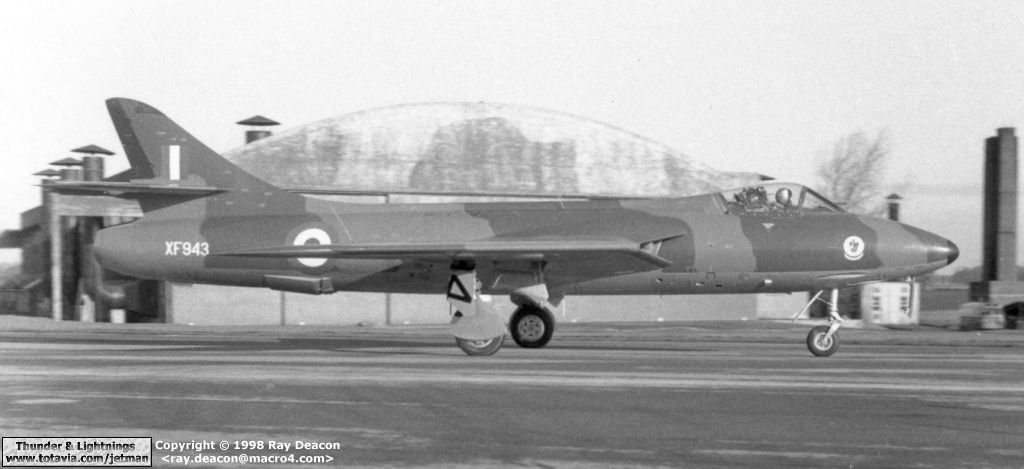
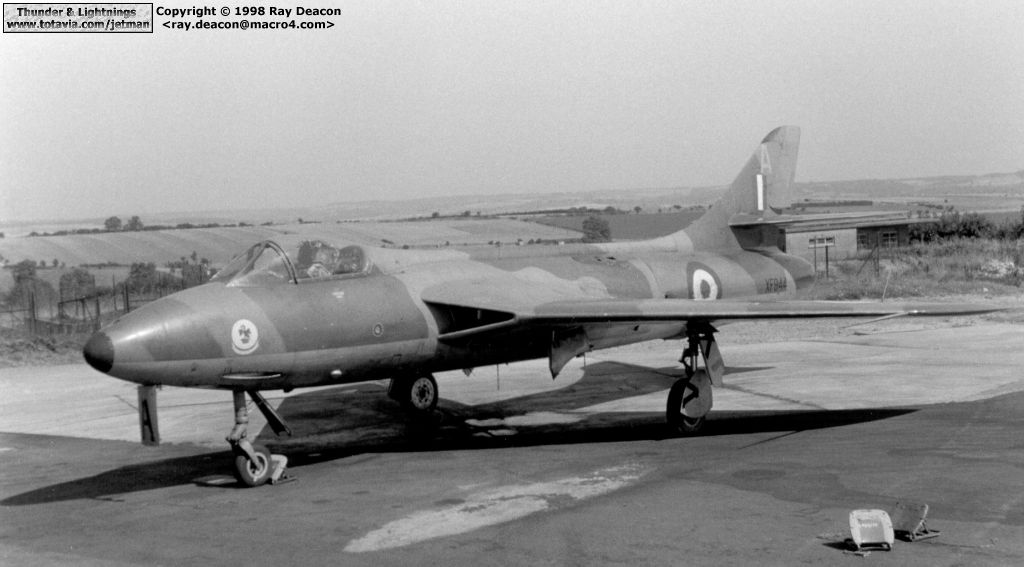
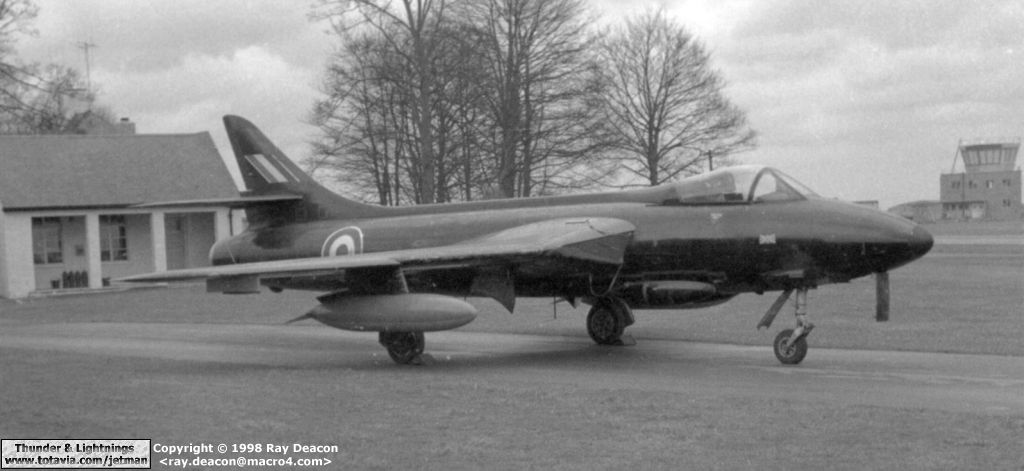
  1. Because of the crowded circuit at RAF Little Rissington, the CFS Hunter flight, which in 1961/2 comprised three F4s, XF943/944/973 and a solitary T7, XL611, was permanently based at RAF Kemble and manned by civilian staff. Late in 1961, its Hunters were refurbished and XF943 "B" glistens in its new coat of camouflage and the CFS Pelican crest on its nose, as it taxis back to its pan in March 1962. This aircraft was unfortunately destroyed in a crash three months later.
  2. CFS Hunter F4, XF944 "A", was photographed during a rare visit to the unit's home base at Little Rissington in 1961. Following a long period in storage, it was converted to F58A standard in 1974 and delivered to the Swiss Air Force as "J4142".
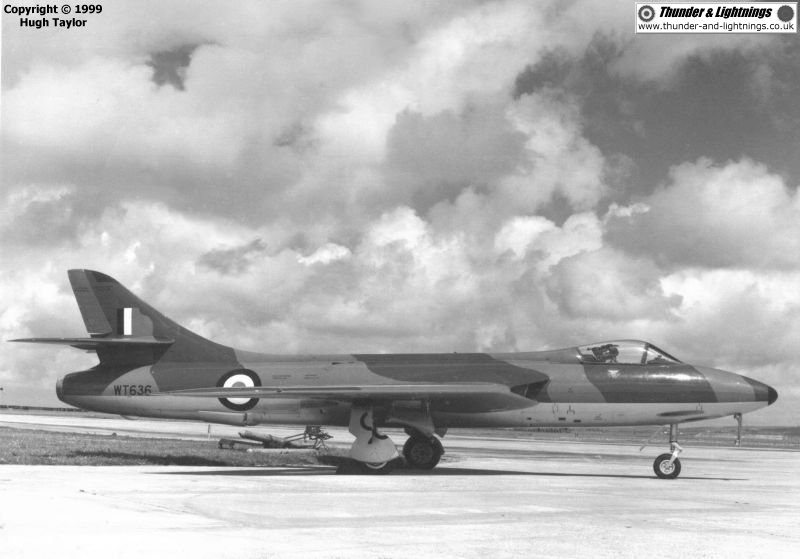
  3. Former "Black Arrows" Hunter F6, XF430, is seen outside one of the 5 MU storage hangars at RAF Kemble in the spring of 1962. Two years later it was converted to FGA9 standard and re-issued to the RAF. In 1977 it was again modified this time as an FGA70A and sold to the Lebanese Air Force as "L283".

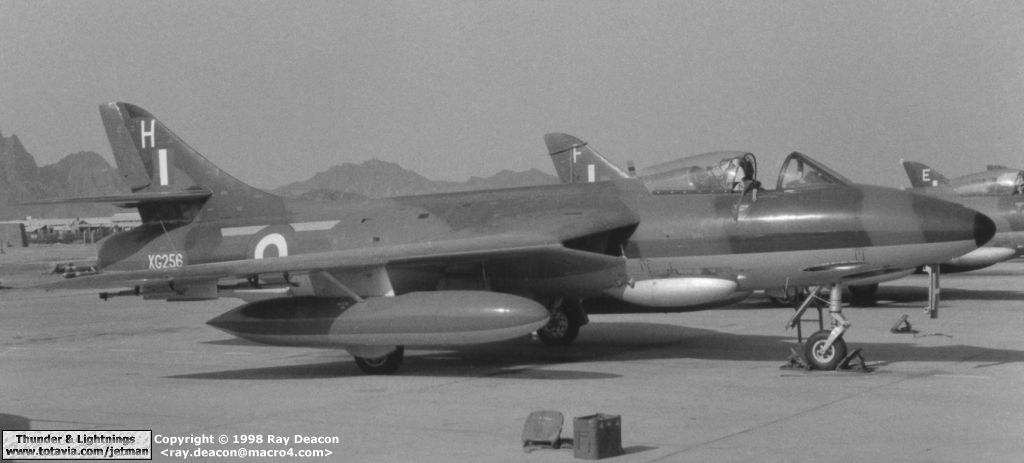
  1. Following the planned invasion of Kuwait in 1961 and the subsequent troubles in the Aden hinterland, the RAF increased the strength of the Middle East Hunter wing from 33 to 46 aircraft. Number 8 squadron had been based in this theatre for nearly forty years and one of its FGA9s, XG256 "H", is seen on the RAF Khormaksar pan in 1963. The rocket rails and 230-gallon drop-tanks were the standard configuration for the period.
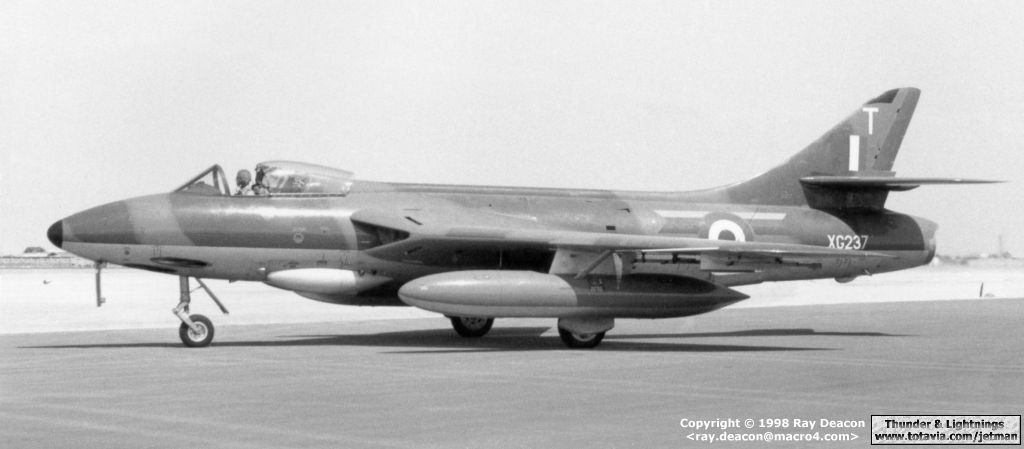
  2. Another 8 squadron FGA9 is depicted in this shot of XG237 "T", as it is taxied out by one of the unit's pilots for a compass-swing on the far side of Khormaksar airfield in 1963. In 1969, it was converted to FGA73A standard and sold to the Royal Jordanian Air Force as "828".
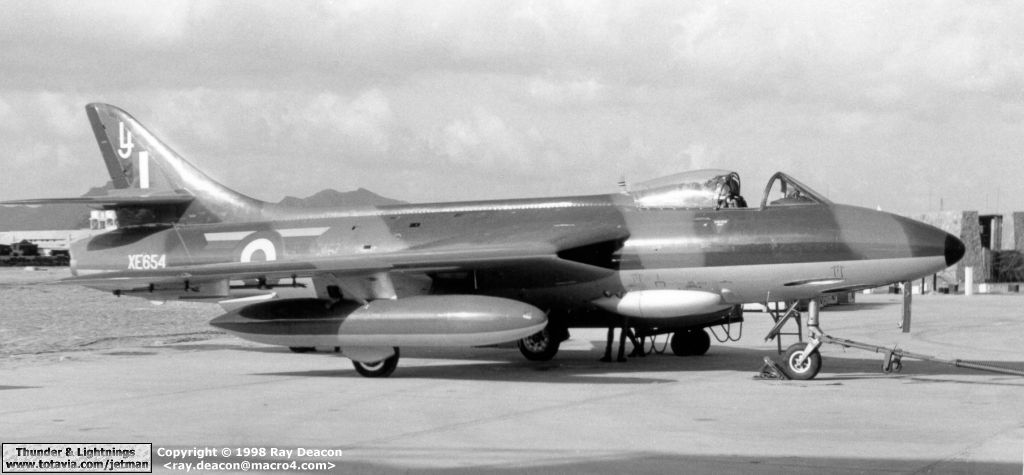
  3. In this view, FGA9, XE654 "LJ", has recently returned to Khormaksar following its bi-annual refurbishment in the UK and is being prepared for its acceptance test. The tail-code letters are the initials of 8 squadron's CO, Sqdn Ldr Laurie Jones.

  1. Four Hunter FR10s were assigned to 8 squadron in 1961 and one of them, XF436 "U", is seen being prepared for an engine run at Khormaksar during the Summer of '62. Of interest is the absence of rocket rails under the wings and the cameras fitted in the nose.
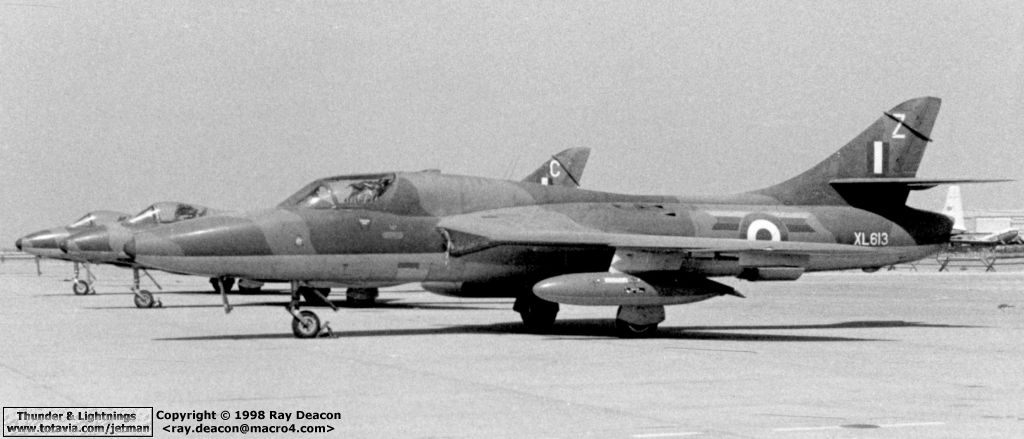
  2. XL613 "Z", was one of two, Hunter T7s operated by 8 squadron until their transfer to a re-formed 1417 Flt in 1963. Seen here basking in the midday sun at Khormaksar during the previous summer, it is currently owned by Classic Jet Aircraft at Exeter.
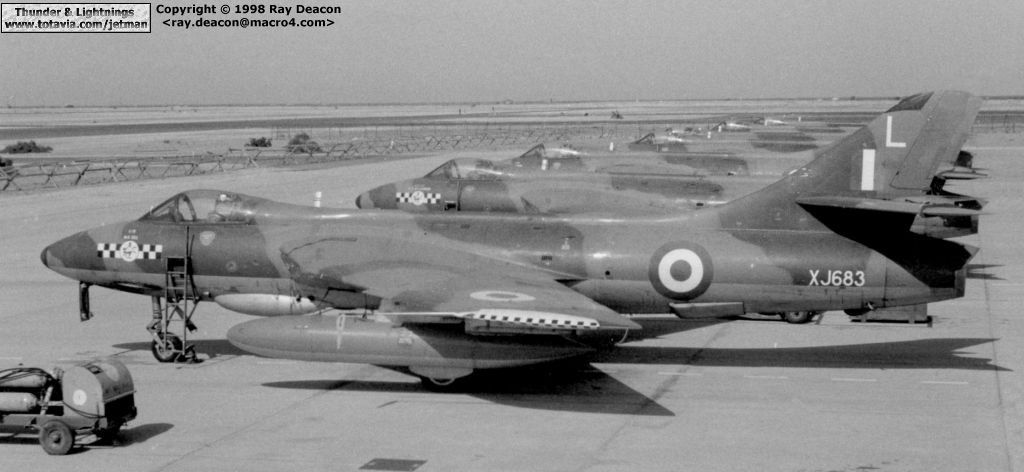
  3. Number 43 squadron FGA9, XJ683 "L", heads a line-up on the Khormaksar pan shortly after the squadron's arrival from Cyprus in March 1963. A couple of months later, it made a wheels-up landing at Bahrain and the front fuselage was severely damaged by fire.

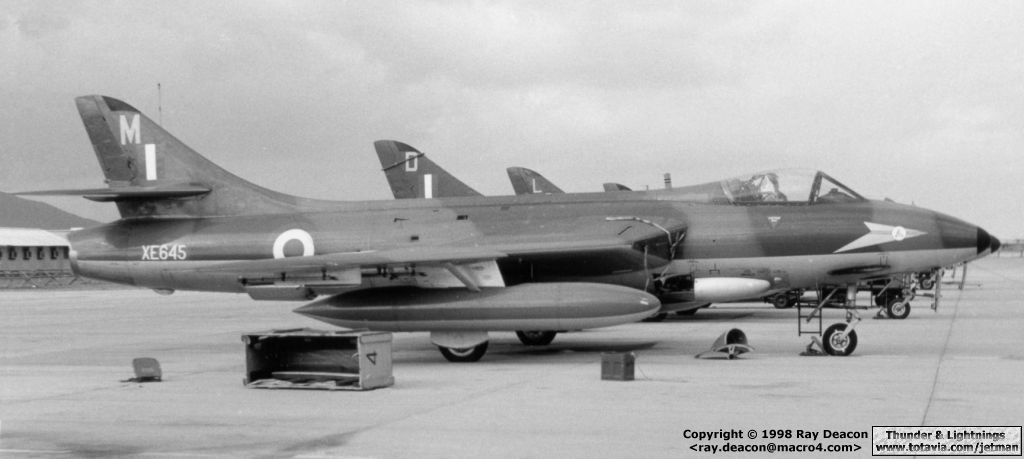
  1. Number 208 squadron moved from Kenya to Aden following the 1961 Kuwaiti crisis and remained there until shortly before the final withdrawal six years later. One of its FGA9s, XE645 "M", is seen awaiting its next sortie on the Khormaksar pan in 1963.
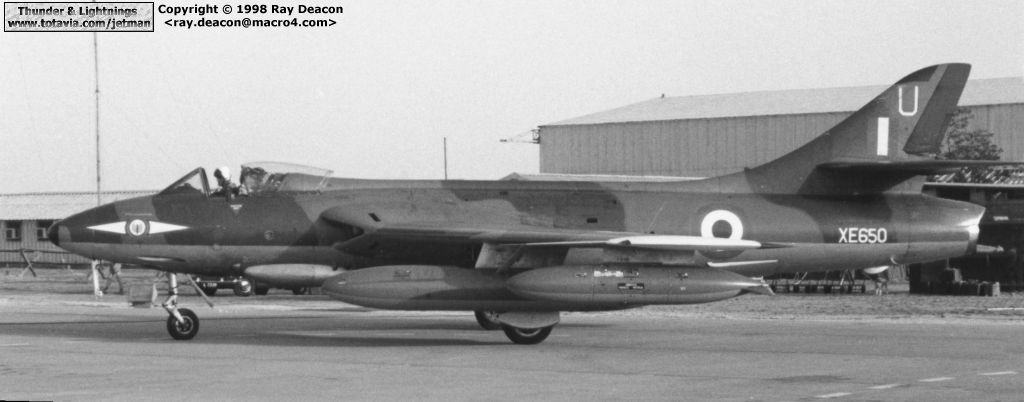
  2. This early-1963 photograph captured FGA9, XE650 "U", of number 1 squadron taxiing-in at Khormaksar after the long ferry flight from the UK via Bahrain to undertake a short detachment. Note the addition of 100-gallon drop-tanks on the outer pylons and absence of rocket-rails to comply with the overflight regulations of different countries.
  3. The only other UK based FGA9 squadron based in the UK in the 1962-4 period was number 54. This unit also paid a visit to the Middle East in early 1963 when XF523 "N" was photographed at Bahrain. This aircraft was lost in a take-off accident shortly after and the pilot safely ejected.

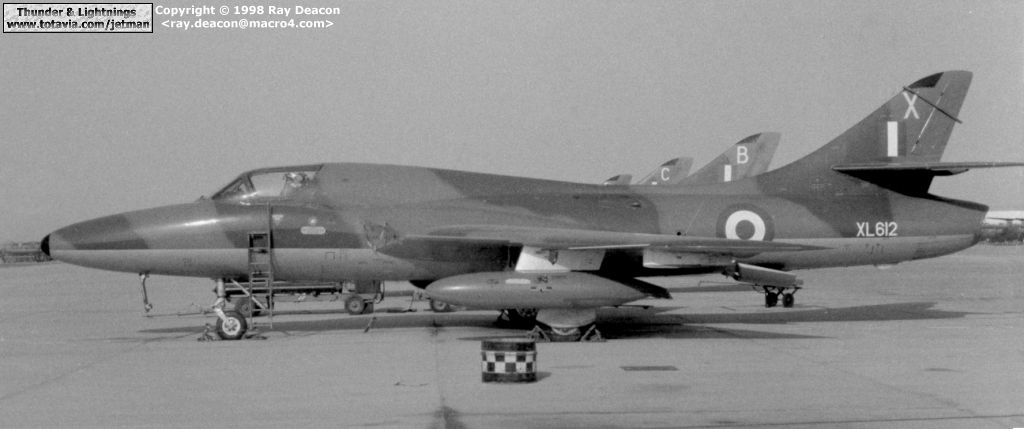
  1. Hunter T7, XL612 "X", was one of four two-seaters assigned to 1417 Flt, which with the aid of four FR10s, satisfied the wing's fighter-recce and training requirements. Here it stands on the Khormaksar pan in 1964 with intakes blanked and flying controls locked during an unusual lull in activities. This aircraft is currently operated by the ETPS at Boscombe Down.
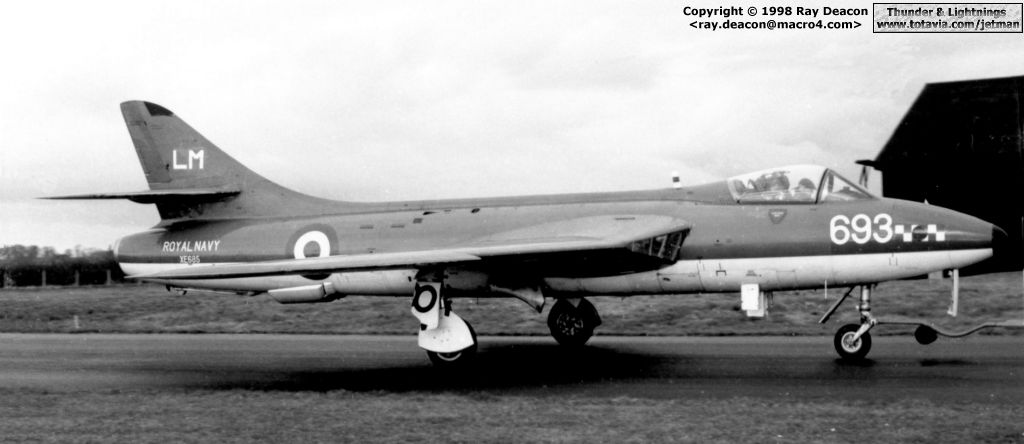
  2. The markings on Hunter GA11, XE685 "693", are those of 764 squadron which was based at Lossiemouth. When this January 1967 photograph was taken, it was being towed out of a storage hangar at 5 MU, Kemble, with an unusual array of aerials under the forward fuselage, prior to being issued to a new unit. Following retirement it was sold to the Classic Jet Aircraft Company at Exeter where it is currently preserved in flying condition.
  3. Undoubtedly one of the most attractive colour schemes ever applied to a naval single-seat Hunter was borne by this PR11, XE689 "696". One of only a handful fitted with an FR10-type camera nose, it is seen in the Spring 1967 about to take off from RAF Kemble after a period in store, still bearing the colours of its previous unit, number 764 Squadron at Lossiemouth. The camera nose was later replaced by a Harley light and the aircraft remained operational until the demise of the Hunter in navy use. It was then purchased by the Classic Jet Aircraft based at Exeter where it joined the company's growing collection of airworthy Hunters.

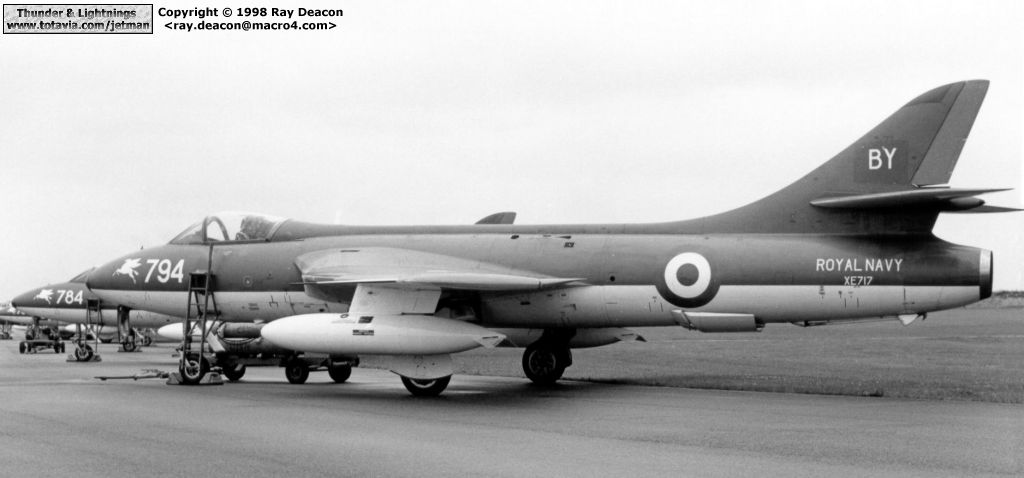
  1. RNAS Brawdy is location for this photograph of GA11, XE717 "794", of 738 squadron on the occasion of the base's Navy Days air show in August 1966. It was one of several naval Hunters sold back to Hawkers for conversion to F58A standard and it was delivered to the Swiss Air Force as "J-4122" in 1972.
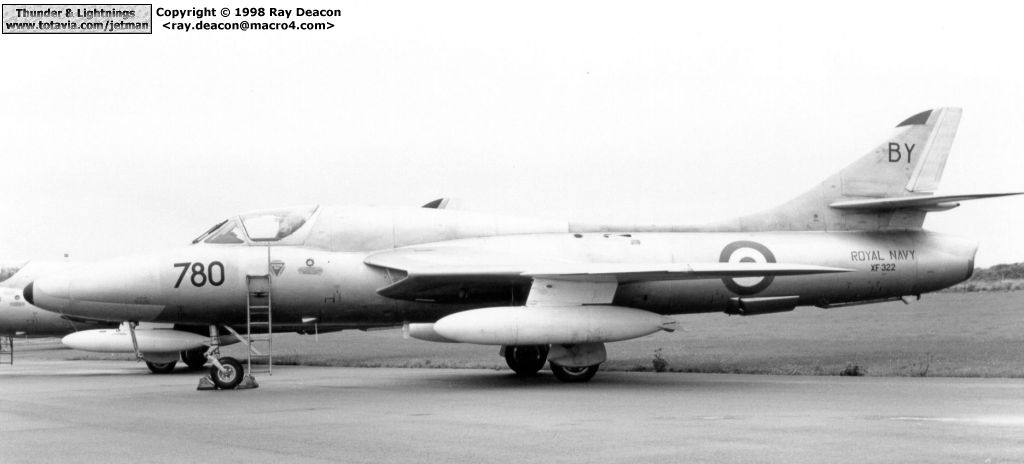
  2. Another Brawdy resident on show at the 1966 Navy Days air show was this 738 squadron T8, XF322 "780". Delivered to the RAF as an F4 in 1956, it was one of several single-seaters converted by Hawkers to T7/8 standard in the late fifties/early sixties.
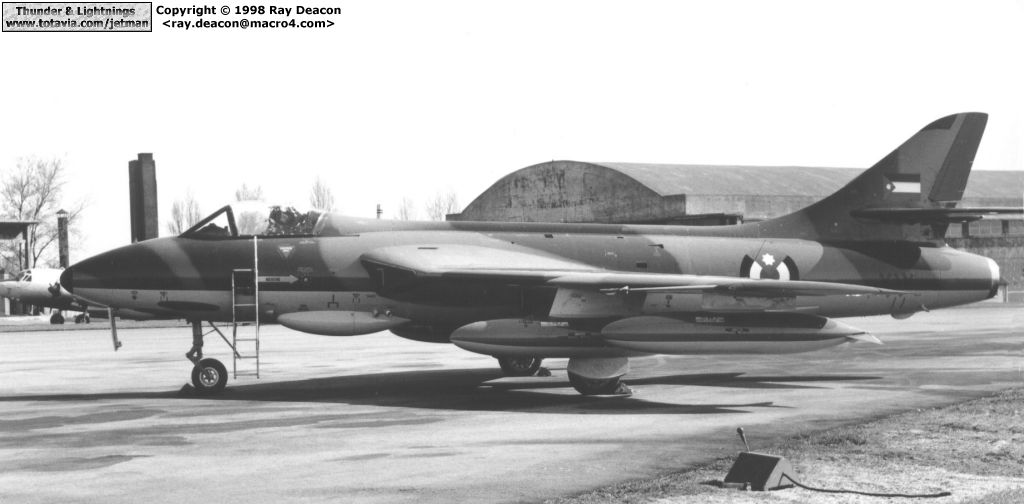
  3. This former RAF Hunter F6 flew into RAF Kemble in the markings of 229 OCU with the serial XG159 in the spring of 1967. Modified to FGA73 standard and repainted in the Royal Jordanian Air Force livery and serial "717", it is seen on the day of its departure for Jordan, just in time to participate in the six-days war.

[Back to top]


All these pages and 'author' credited images copyright © 1997-2007 Handmade by Machine Ltd.