
British Aircraft Corporation TSR2 - Survivors

Two complete airframes, XR220 and XR222, survived and have both been restored to good static condition. All the other TSR2 airframes along with the only TSR2 to fly were eventually scrapped as mentioned in the history section.
Complete aircraft
| Serial | Mark | Owner & location | Updated |
| XR220 | Type 571 | RAF Museum Midlands, RAF Cosford, Shropshire | 24/04/2022 |
| XR222 | Type 571 | Imperial War Museum, Duxford Airfield, Cambridgeshire | 02/03/2021 |
Nose/cockpit/other sections
| Serial | Mark | Owner & location | Updated |
| T5 | Type 571 | Brooklands Museum, Weybridge, Surrey | 08/01/2022 |
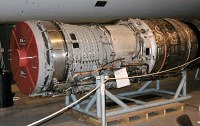
Olympus 320X ECU, Science Museum Wroughton, 2005; Martin Gatter
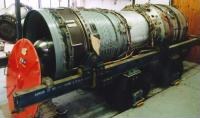
Olympus 320X ECU, Gatwick Aviation Museum, 17th July 1997; Dick Clements
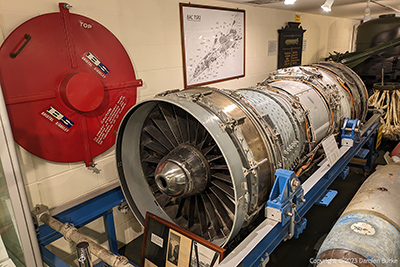
Olympus 320X ECU 22217, Combined Military Services Museum, 30th September 2023; Damien Burke
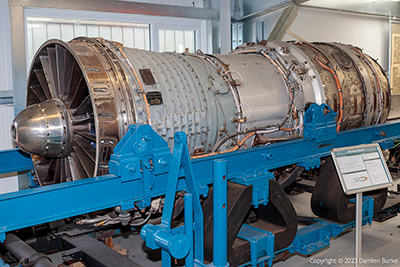
Olympus 320X ECU 22219, Gatwick Aviation Museum, 6th August 2023; Damien Burke
Various parts of TSR2 are scattered around the country - Bristol-Siddeley Olympus engines that were used in, or destined for TSR2s are the most common items. The Gatwick Aviation Museum have engine 22219 (ground run in both XR219 and XR220); the Combined Military Services Museum have engine 22217 (flown in XR219 twice) and the Science Museum at Wroughton and RAF Museum Midlands at Cosford also have engines - Cosford even have the associated reheat unit. Several wing sections were to be found at Foulness for some years but were sold and scrapped in 1995. A main wing apex section can be found at the Newark Air Museum; an engine access door is also there, in the engine display hall (this is from XR222 - XR222 has a replacement!). Various other small items survive, e.g. a partial pressure helmet is in store with the RAF Museum, and Cosford also have a TSR2 ejector seat and a publicity model. Canopies can be found at the Midland Air Museum (who also have an ejector seat) and also reportedly still in use as a training aid at RAF Halton.
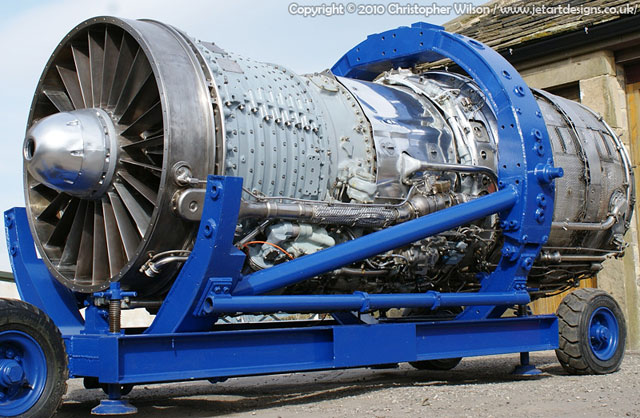
In April 2010, an unusual survivor came to light - the very first Olympus 22R, serial 2201, which had been stored for over 40 years, has been restored and was up for sale on eBay. This particular engine underwent considerable bench test running, tearing itself to bits twice in the process, and was rebuilt each time to continue with its valuable development work. Quite a find - and deserving of a place in a museum somewhere.
Pazmany PL.1 G-BDHJ at Bodmin Aerodrome, early 1997; Martin Pengelly
There is a strange little postscript to the TSR2 saga, involving another aircraft that has a little TSR2 heritage... some of the metal destined for the production TSR2s was instead used in the manufacture of G-BDHJ, a Pazmany PL.1. This is a light trainer type aircraft, which has been used as a basic trainer by the Chinese air force. However, the one in question here wasn't used by the Chinese - it first flew in 1971, and was for some time based at Bodmin aerodrome in Cornwall. It's a world apart from the TSR2, but I thought that it merited a mention! Sadly the aircraft has not flown since 1997 and is no longer on the CAA register.